


Designing Cohesive Campaign Experiences
Across Dynamic Content, AI and Multiple Formats
FROM GENERATIVE EXPLORATION TO MANUAL COMPOSITING, EACH CAMPAIGN HAD TO REMAIN CLEAR, ACCURATE AND RECOGNISABLE ACROSS CUSTOMER-FACING TOUCHPOINTS. SELECTED PROFESSIONAL WORK PRODUCED THROUGH VELTI FOR GOODY’S / ALL STAR CLUB. ORIGINAL CLIENT AND THIRD-PARTY VISUAL ASSETS ARE NOT REPRODUCED IN THIS PORTFOLIO VERSION. RECONSTRUCTED EXAMPLES PRESERVE THE DESIGN LOGIC, CONTRIBUTION AND PRODUCTION WORKFLOW WITHOUT REPRODUCING PROTECTED BRAND MATERIAL.THE CAMPAIGN CONTEXT
- What it was
- A recurring stream of customer-facing loyalty and promotional communications produced for Goody’s / All Star Club through Velti, including monthly reward campaigns, standard newsletters and supporting digital formats.
- What had to remain consistent
- Each campaign needed to preserve the same visual concept, promotional message and brand feeling across very different placements, from tall mobile formats to wide desktop and website banners.
- Where the complexity lived
- In translating incomplete or evolving campaign direction into a visual system that could support copy, offers, products and calls to action without losing clarity across different proportions.
- How the work was delivered
- I created the campaign artwork, format adaptations, modular image assets, GIFs and source files. The final HTML newsletter assembly was completed in collaboration with a developer.
WHAT I BROUGHT
- What it demonstrates
- How I combined generative AI, visual concept development, manual compositing and production-aware design to create customer-facing campaign experiences.
- Scale of the work
- Across approximately ten months, I supported one recurring monthly reward campaign adapted into seven predefined formats, alongside additional newsletters and promotional assignments.
- What I contributed
- Visual interpretation, concept development where required, prompt direction, AI-assisted scene creation, Photoshop compositing, typography, offer hierarchy, product validation and multi-format adaptation.
- Why this product, specifically
- It shows how I use AI inside a controlled professional workflow: not as a substitute for design judgment, but as a way to explore faster, create tailored visual environments and prepare flexible assets for real production constraints.
RIGHTS-SAFE PUBLICATION STATE
The first portfolio version uses reconstructed or anonymised visuals while preserving the real design logic, contribution boundaries and production method. Approved original assets can later replace those references without changing the case-study structure.
The Communication Context
The work supported recurring promotional and loyalty communications distributed through newsletters, mobile and desktop placements, website banners and other customer-facing surfaces. The client typically knew the reward, featured product or commercial mechanism. The visual direction, however, ranged from fully specified to only loosely defined.
Some briefs included finished copy and a broad idea. Others arrived with no developed visual concept. From a certain point onward, rough AI-generated references were occasionally used by the client to communicate an intention. These references were not production assets; they functioned as a faster shared visual language that helped reveal what stakeholders were trying to describe.
My responsibility was to interpret that direction, build a professional visual concept, validate it against brand and product requirements, and prepare production-ready assets for the final newsletter or campaign placements.
STARTING POINT
Known reward, product, offer or campaign mechanism; always supplied copy; sometimes an incomplete visual direction or rough AI reference.
DESIGN RESPONSIBILITY
Translate intent into visual hierarchy, scene composition, editable copy, accurate product representation and a campaign system capable of working across required formats.
DELIVERY REALITY
Most campaigns moved through one or two meaningful review iterations. Artwork, modular image assets, JPEG/GIF exports and source files were delivered for developer assembly.
Rough AI references reduced ambiguity. The professional design work still required reinterpretation, rejection, art direction and complete production control.
Why Cross-Format Coherence Was the Real Design Problem
Monthly reward campaigns were not single images. Each one had to work across seven predefined formats, from very tall portrait placements to wide landscape banners and full-screen digital surfaces. The format set remained stable; each new concept had to survive the same system.
The solution was to create a format-resilient master scene. After generating the core image, I extended the environment into a broader, near-square source canvas. The focal subject remained protected near the centre, while enough background was preserved for repositioning, copy space and contrasting crops.
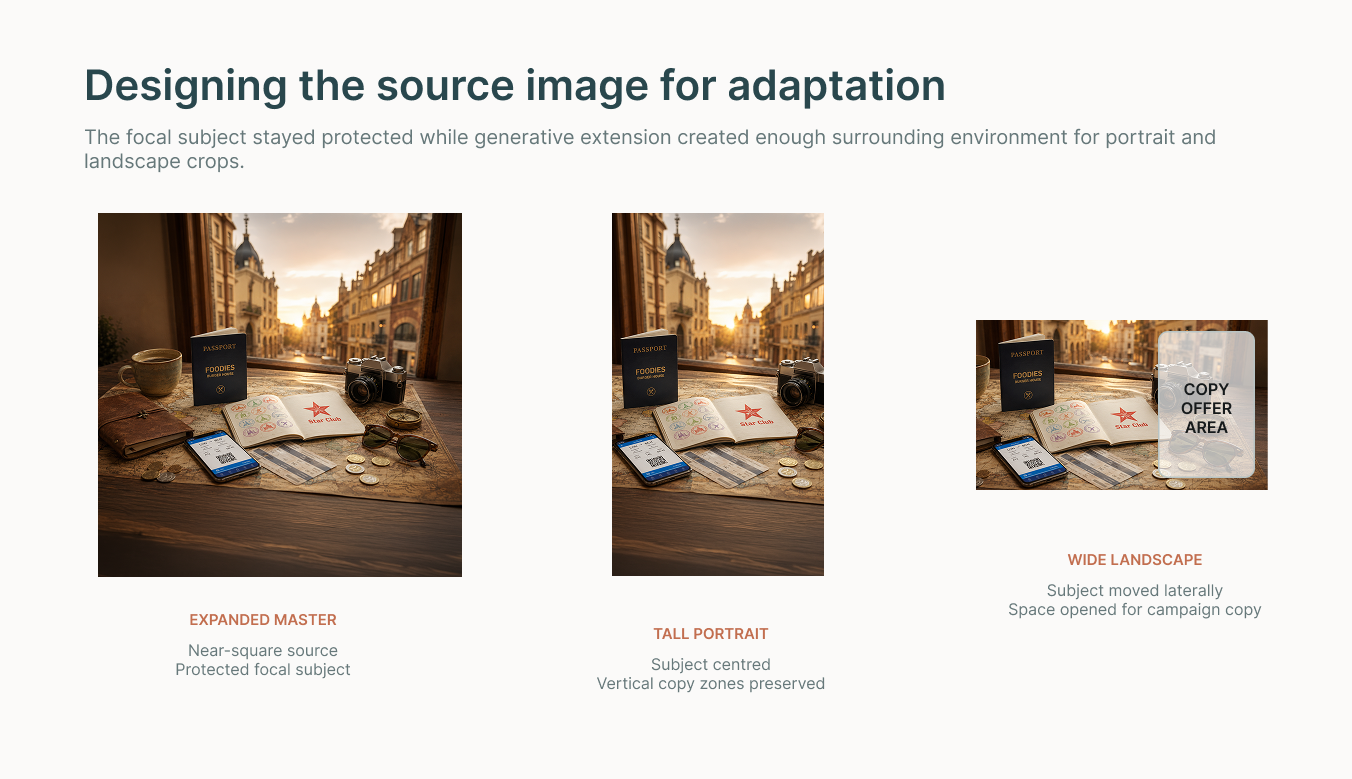
The source image was designed for adaptation before the adaptations were created.
The Hybrid AI + Manual Production Workflow
The workflow combined conversational prompting, generative image tools, manual visual design and implementation-aware asset preparation. AI accelerated exploration and scene creation; it did not determine the finished campaign.
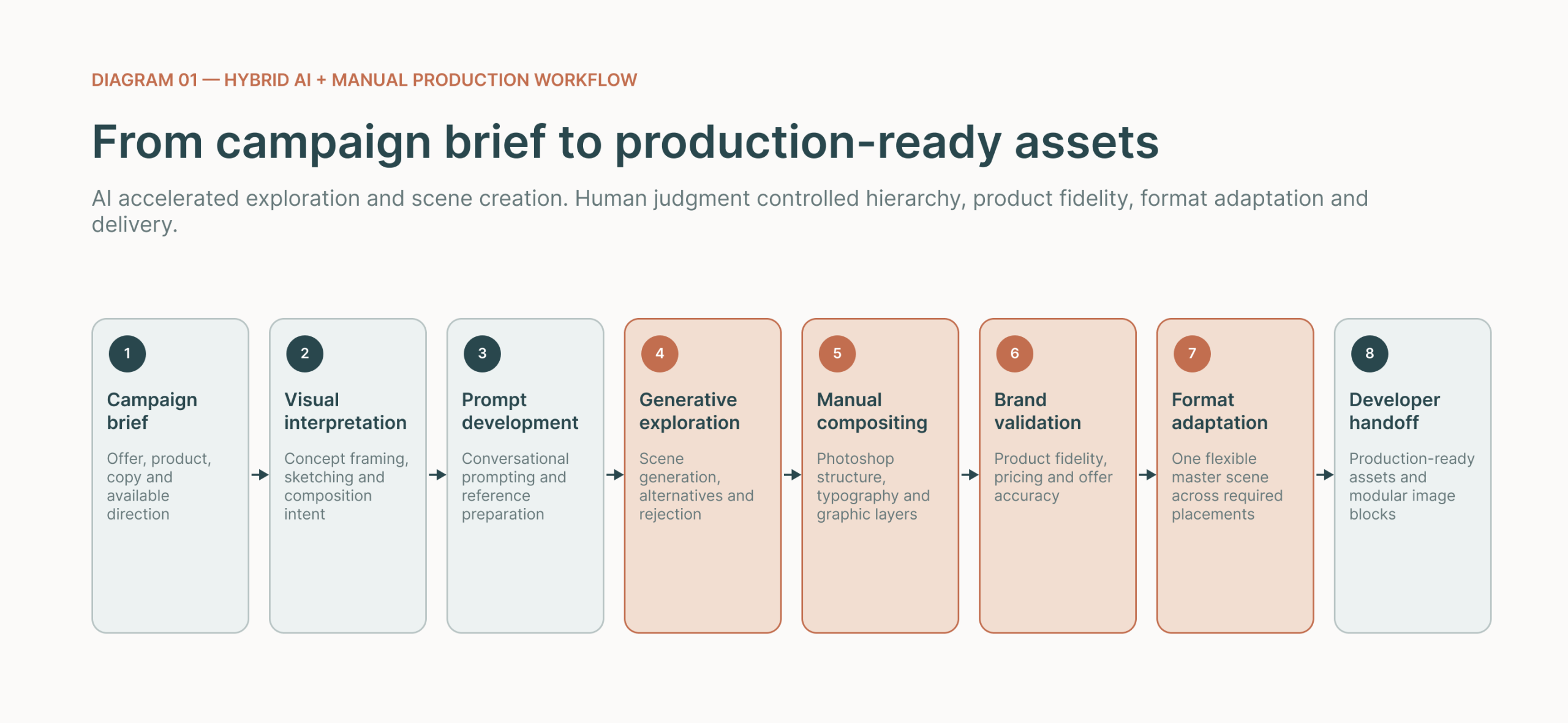
AI SUPPORTED
Complete scene generation; separate visual elements; rapid concept exploration; reference-guided variation; alternative food arrangements; generative expansion; local image changes; and tailored environments unavailable through stock photography.
DESIGNER REMAINED RESPONSIBLE FOR
Typography, campaign copy, prices, CTA, legal and
promotional details, logo placement, hierarchy, brand treatment, product fidelity, final compositing and delivery decisions.
TOOLS AND PRODUCTION ENVIRONMENT
ChatGPT was used both as a conversational prompt editor and an image-generation environment. Gemini was also used for image generation. Photoshop was the final production environment; Illustrator supported vector and graphic elements where required.
The visuals shown here are close portfolio replications of the original campaign work, recreated to preserve its design direction and production logic while respecting client confidentiality, intellectual property and brand restrictions.
Featured Example: Original Concept and AI-Assisted World-Building
The reward was known, but there was no developed visual concept. I created a travel-themed scene that connected ordering, loyalty participation and the possibility of winning a travel gift.
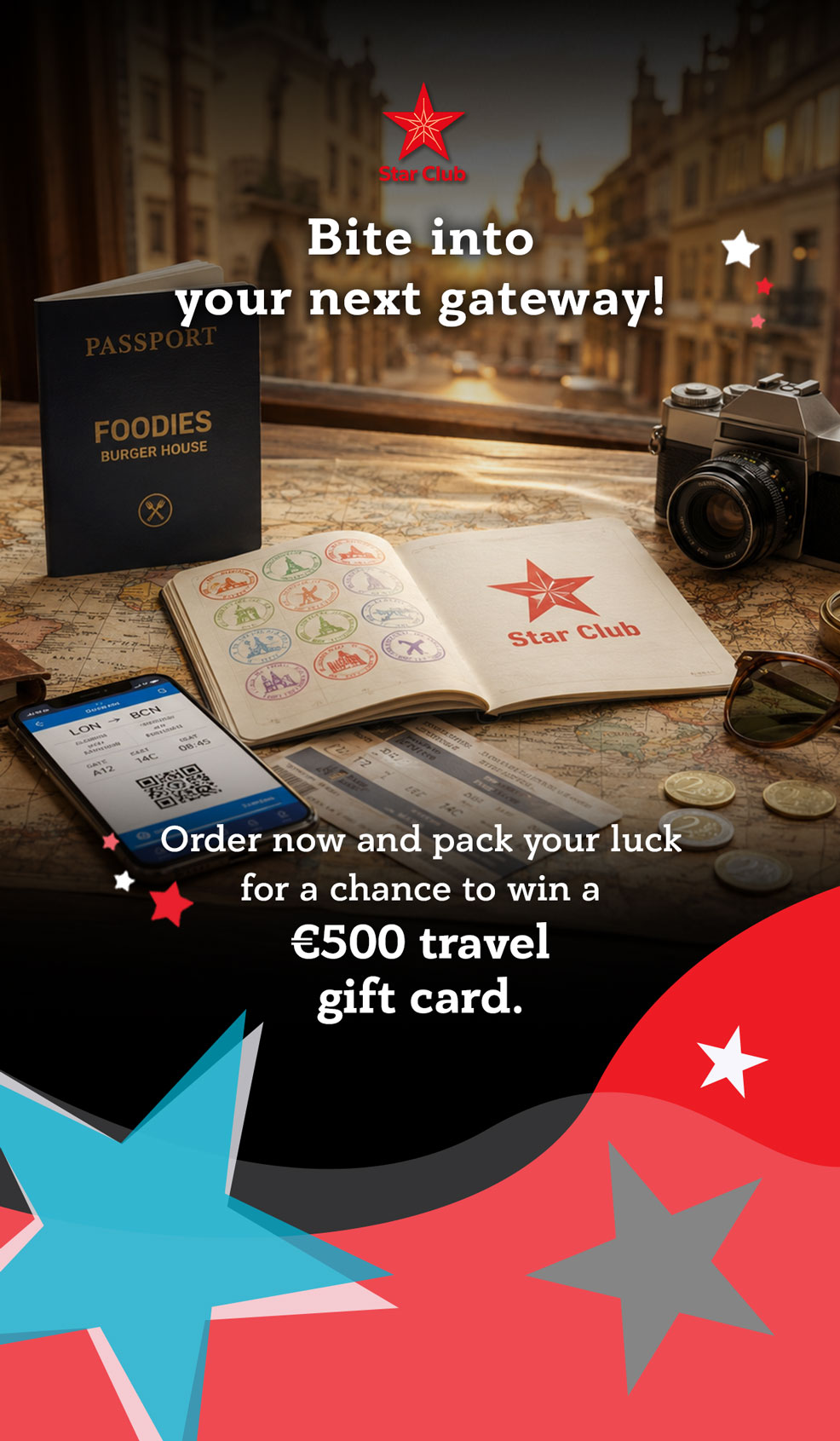
DESIGN INTENT
Build a recognisable travel world around the reward rather than placing a generic destination photograph behind the campaign copy.
AI CONTRIBUTION
Generate a tailored desktop travel scene with map, camera, phone boarding pass, coins, compass and environmental depth.
HUMAN CONTRIBUTION
Develop the concept, direct the scene, create the custom brand-world passport details, establish hierarchy, add copy, logo, promotional badge, flames and final artwork in Photoshop.
CONCEPT OWNERSHIP
The travel visual concept and scene logic were developed by me from an open brief.
DISTINCTIVE DETAIL
A custom passport was treated as an object from the brand world, including travel stamps and an RFID-style passport symbol rather than remaining a generic prop.
PRODUCTION STATUS
The original campaign was approved, published and used in live customer communications. The public portfolio version should use a rights-safe reconstruction until approval is confirmed.
Featured Example: Collaborative Concept and Visual Transformation
The supplied direction focused on a futuristic gaming room with screens, LED lighting, gaming equipment and a premium technology atmosphere. I interpreted the phrase “glow up” as a before-and-after transformation of the same person.
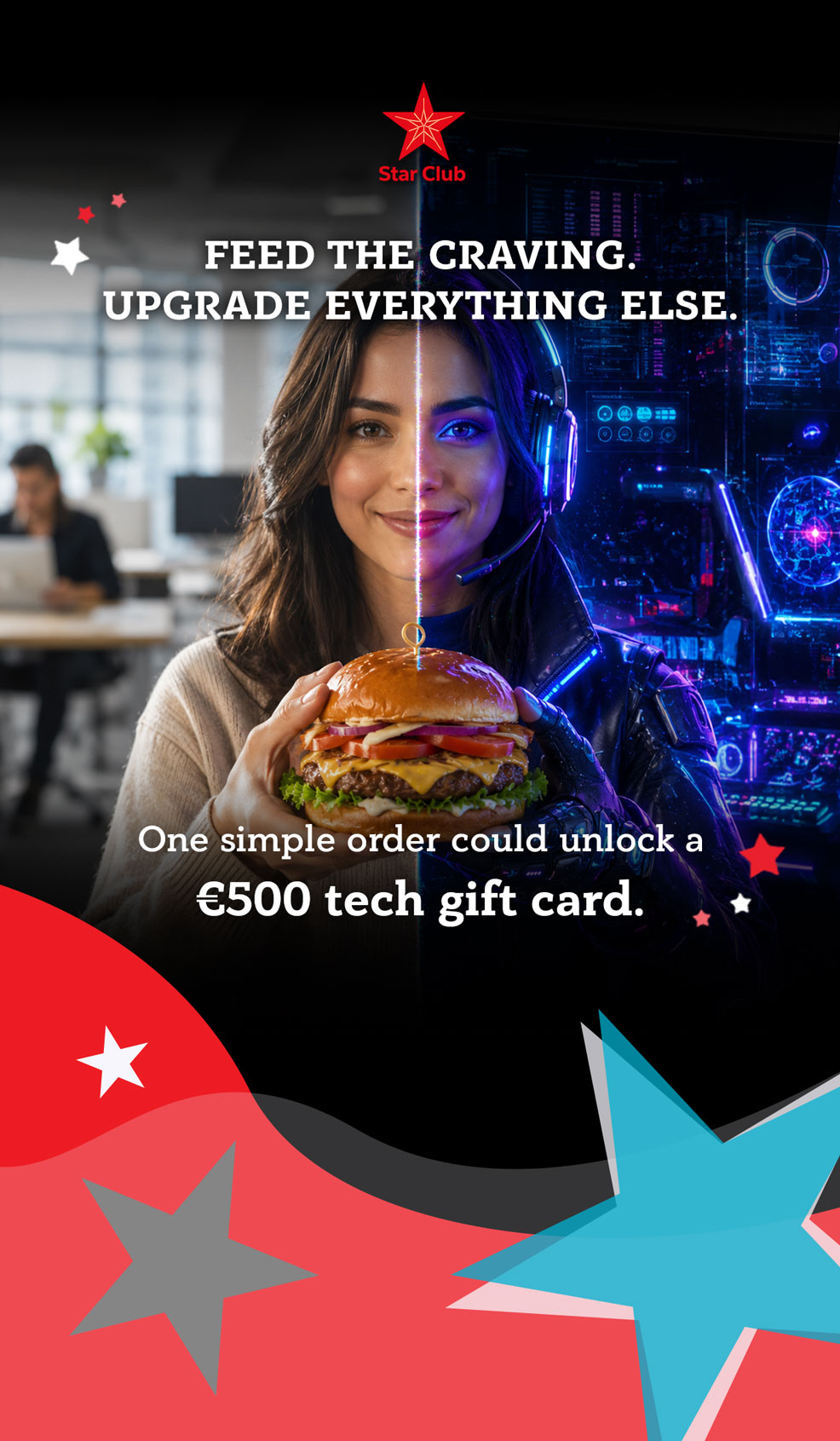
SUPPLIED DIRECTION
A high-tech gaming environment and technology-upgrade reward.
DESIGN DEVELOPMENT
Transform the message into a visual narrative: the same young person before and after the upgrade, with both personal styling and the surrounding environment changing.
AI + PHOTOSHOP
Use a previously generated gaming-room scene as reference, guide product resemblance with a burger reference, then add the central glow divider, typography, branding and campaign graphics manually.
CREATIVE MODEL
The final direction was collaborative: client input shaped the gaming environment, while my contribution introduced the before/after transformation narrative and developed it into the final composition.
NARRATIVE VALUE
The transformation gives the reward a story rather than presenting technology as a decorative background.
OWNERSHIP BOUNDARY
The case study must not describe the whole concept as exclusively mine. It should distinguish supplied direction, collaborative iteration and my visual resolution.
Featured Example: Iteration, Rejection and Refinement
The first direction explored an immersive science-fiction world with holograms, gadgets, laser light and a character moving into a technology dimension. The idea did not produce the right campaign result and was deliberately abandoned.

ITERATIVE SHIFT
The campaign moved toward the brand’s recurring themes of friendship, youth and shared experience. A group opening gifts became the central scene.
PORTAL EVOLUTION
The portal changed function through review: from visual elements emerging from the gift box to an expanded background environment behind the group.
FINAL PRODUCTION
The base visual remained one generated scene. Typography, logo, stickers, flames and the complete promotional hierarchy were built manually in Photoshop.
The value of generative exploration was not that every output was used.
It allowed directions to be evaluated, rejected and redirected before full production investment.
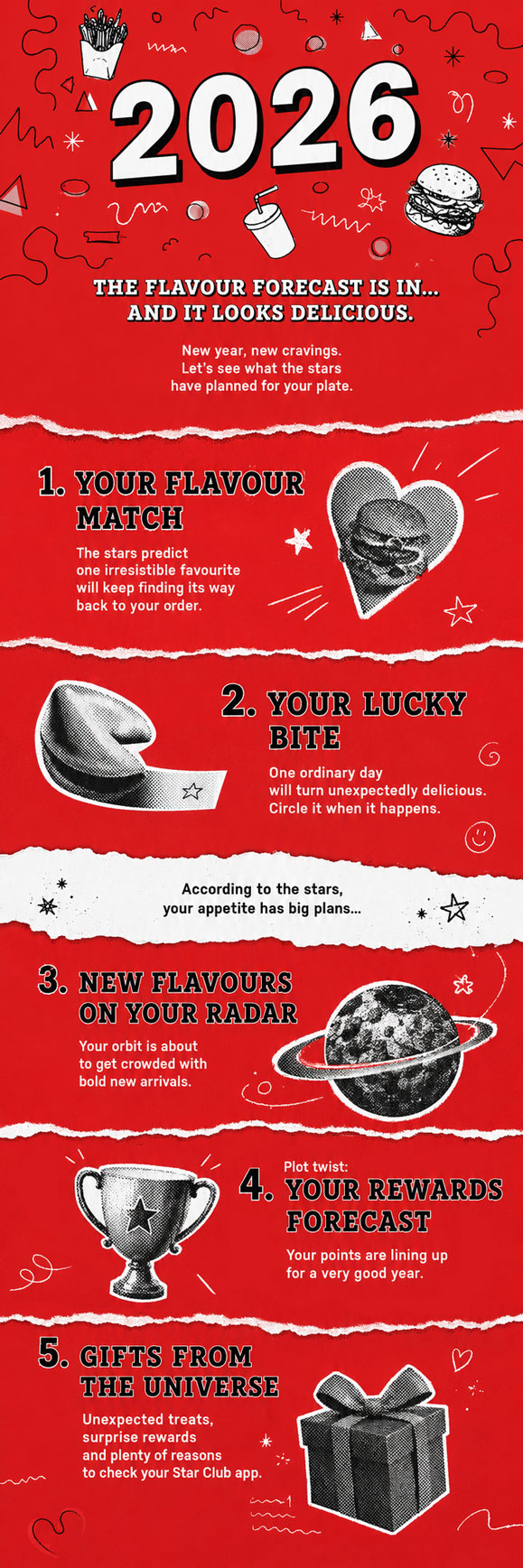
Supporting Example: Dynamic Content Inside a Continuous Visual Story
The campaign concept and data logic were defined by the client’s marketing team. Dynamic fields used behavioural information such as approximate future order count, favourite item and common ordering day to create a personalised year-ahead prediction.
The technical challenge came from the newsletter distribution system. The experience could not be delivered as one static image because personalised values had to be inserted dynamically. At the same time, the design needed to feel like one continuous long-form visual.
STRUCTURAL RESPONSE
The newsletter was divided into multiple image sections. Dynamic fields were inserted between those segments, while matching background treatments made the transitions appear continuous.
COLLABORATION
I worked with the developer to understand the technical limitations, plan image boundaries and preserve the visual flow around variable content.
DELIVERY EVIDENCE
The personalised version was implemented and distributed. No open-rate, click-through or conversion data is available for this case study.
My role was not to invent the data model. It was to translate the supplied concept and dynamic fields into a continuous visual experience that could be built within the available system.
Human Validation of AI-Generated Product Imagery
Existing product photography provided essential references but could become visually repetitive across recurring campaigns. AI made controlled variation possible, but every food image still had to preserve the commercial identity of the real product.
REFERENCE-LED GENERATION
Official product imagery guided form, ingredient relationships and recognisability.
LOCAL CORRECTION
Photoshop corrections refined surface details, texture, colour or small composition errors without rebuilding the entire scene.
FALLBACK TO REAL ASSETS
Real product photography remained the right solution whenever generated imagery could not meet the required fidelity.
Generative flexibility could not come at the expense of product accuracy.
This validation step is where AI output became usable commercial material: not because it looked plausible, but because it was checked against the product customers would actually receive.
Review, Adaptation and Delivery
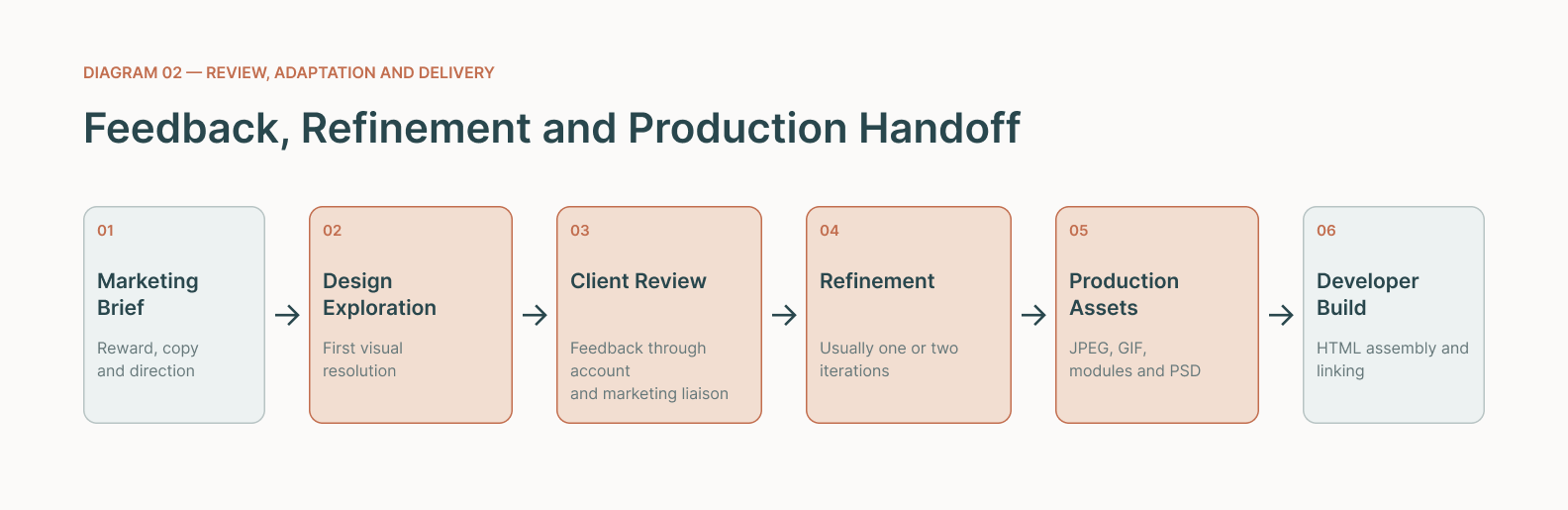
The review loop ran through a dedicated account and marketing liaison: Goody’s Marketing shared feedback with the liaison, who communicated it to me, while the resulting designs followed the same path back to the client. Most campaigns reached an aligned direction within one or two iterations.
As the visual direction became clearer, campaign copy was occasionally refined so the message matched the tone and energy of the final composition. Over time, repeated collaboration also helped me understand less explicit aesthetic preferences and reach aligned solutions faster.
Campaign work moved through short production cycles and often ran alongside other active deliverables. Some assignments involved the same-day adaptation of existing supplied material into technically usable newsletter assets.
MY DELIVERY
Master artwork, format variations, modular image assets, occasional GIFs, exports and source files.
DEVELOPER RESPONSIBILITY
HTML newsletter assembly, placement of linked image modules and technical distribution build.
IMPLEMENTATION BOUNDARY
The case study must show design-development collaboration but must not claim that I coded or implemented the newsletter.
What This Work Changed in My Practice
Beyond the individual campaign outputs, this work reshaped how I approached AI-assisted visual design, production constraints and collaboration. The following principles became part of my broader design practice.
PROMPTS AS DESIGN
COMMUNICATION
Conversational prompting became a way to turn intuitive visual direction into structured exploration. Rough AI references also helped stakeholders communicate ideas that were difficult to express in words.
FLEXIBLE SOURCE CREATION
The most valuable generated image was not always the most finished one. A useful source scene needed protected focal areas, negative space and enough environmental range to support later formats.
HUMAN CONTROL
AI could propose scenes and variations, but typography, commercial information, brand fidelity, product accuracy and final hierarchy remained explicit design responsibilities.
EXPLORATION BEFORE INVESTMENT
Rapid alternatives made uncertainty cheaper. A direction could be discussed or rejected before hours were invested in detailed Photoshop production.
DESIGN-DEVELOPMENT ALIGNMENT
The Predictions campaign reinforced that visual concepts need technical alignment to become functional communications. Understanding image segmentation and dynamic fields was part of the design work.
COMMERCIAL VISUAL SYSTEMS
A campaign was not complete when one image looked good. It was complete when one recognisable idea could survive all required outputs and reach production reliably.
AI did not remove the need for design judgment. It increased the number of decisions that had to be made deliberately.
The Principle
The real test of an AI-generated visual was whether it stayed accurate, recognisable and useful across every required format.
A generated image was only the starting point. The campaign emerged through format planning, product review, hierarchy, iteration and production delivery.